Baal Aadhaar Under 5
Baal Aadhaar is Aadhaar for a young child. If your child is under five, this guide explains, in plain English, what Baal Aadhaar is, why the card is blue, why no biometrics are taken under five, how enrolment at a centre works, what documents are needed in general terms, and the two mandatory biometric updates at age five and at age fifteen.
This is an independent guide. It is not the official UIDAI website, and this site does not collect your child’s details, your Aadhaar number, password, or one-time code. Enrolment is done at an official centre, in person.
What is Baal Aadhaar?
Baal Aadhaar is the Aadhaar issued to children under five years of age. It gives the child an identity number in the same system as adult Aadhaar, so the child can be recognised in official records as they grow.
The card for a young child is blue in colour. That blue colour is the simple way to tell a Baal Aadhaar card apart from the usual white adult card. The colour does not mean a different system: it marks a card issued before biometrics were taken.
No biometrics under five: why?
For children under five, no fingerprints or iris scan are taken. Young children’s fingerprints and iris patterns change quickly as they grow, so capturing them at that age would not give a reliable long-term record.
Instead, a child’s Baal Aadhaar is linked to a parent’s or guardian’s details at enrolment. The child’s photograph is taken, and the parent’s or guardian’s identity is used to support the enrolment, as the centre requires.
Enrolment at a centre: step by step
Baal Aadhaar enrolment is a centre task. It is not finished online, because the child must be present and the documents must be checked in person.
- Find a nearby Aadhaar enrolment centre or Aadhaar Seva Kendra, using the official centre locator on our homepage.
- Visit the centre with your child.
- Fill in the enrolment form for the child, with the parent’s or guardian’s details as the centre asks for them.
- Show the documents the centre asks for, in the general categories below.
- Have the child’s photograph taken at the centre.
- Collect the acknowledgement slip given after enrolment, and keep it safe. It is the receipt for that enrolment.
Documents: general categories only
The centre will ask for documents in general categories. Do not rely on a single list from an unofficial site, because the exact accepted documents can change.
- Proof of the child’s identity and date of birth: a document showing who the child is and when the child was born.
- Proof of address: a document showing where the family lives.
- Proof of relationship: a document linking the child to the parent or guardian named at enrolment.
- The parent’s or guardian’s identity: the parent or guardian should also carry their own identity documents, as the centre requires.
Take originals where asked, and keep copies for your own records. If you are unsure whether a particular document will be accepted, ask the centre before your visit, rather than travelling with only one option.
Mandatory biometric updates at age five and at age fifteen
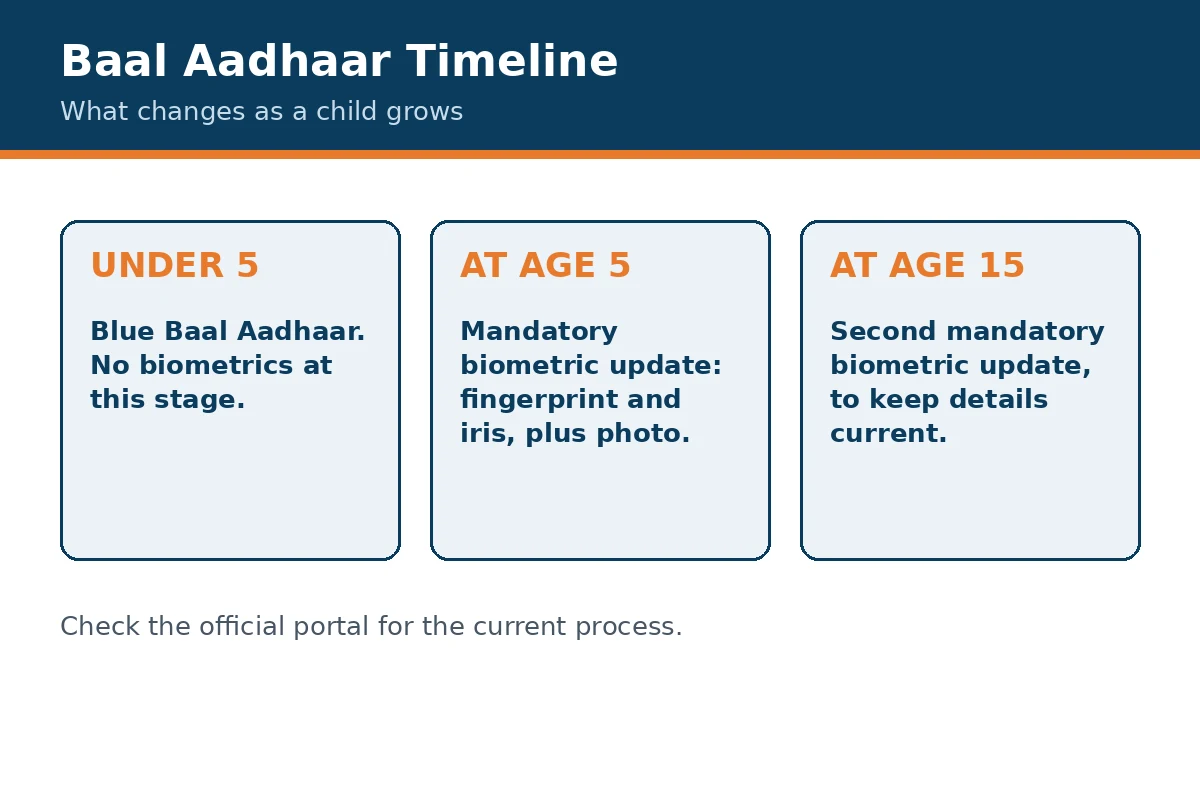
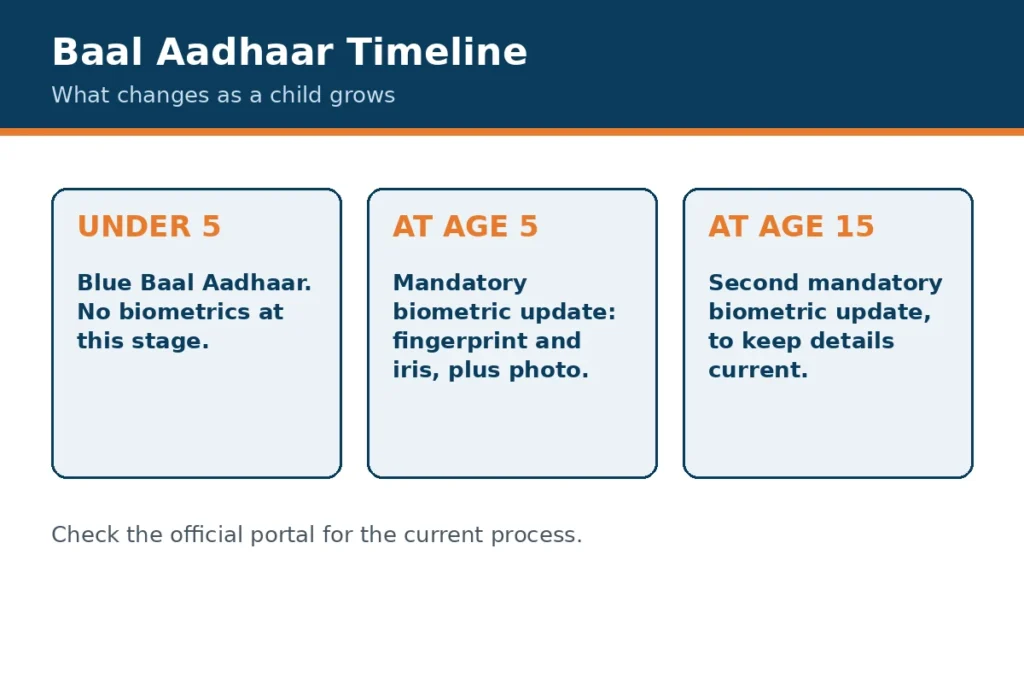
Baal Aadhaar is not finished at enrolment. Because no biometrics were taken under five, two mandatory biometric updates follow as the child grows:
- At age five: the child’s fingerprints, iris details, and photograph must be updated at a centre. This is the first mandatory biometric update.
- At age fifteen: a second mandatory biometric update is required at a centre, because the child’s biometrics change again during growth.
These updates are done in person at a centre, for the same reason as enrolment: biometrics must be captured directly from the child. Do not leave them until the last moment, especially if the card will be needed for school or other official purposes.
What changes as the child grows?
- Under five: blue Baal Aadhaar card, no biometrics, linked to a parent or guardian.
- At five: first biometric update, with fingerprints, iris details, and a new photograph.
- Between five and fifteen: the card is used as a normal Aadhaar, with the updated biometrics on record.
- At fifteen: second biometric update, to keep the record accurate as the young person grows.
- After fifteen: the record is kept up to date like any other Aadhaar, with updates at a centre when details or biometrics change.
Fees to know
UIDAI’s home page states that the mandatory biometric update for children aged five to seventeen is free at Aadhaar centres until 30 September 2027. Last checked on UIDAI: 3 November 2026. See the official UIDAI home page for the current wording, and the full fee table on our homepage. If your child’s update falls outside that free window, or you are unsure, check the official UIDAI page before you visit, so you are not surprised by a charge.
Keeping a child’s Aadhaar safe
- Keep the acknowledgement slip and the card in a safe place at home.
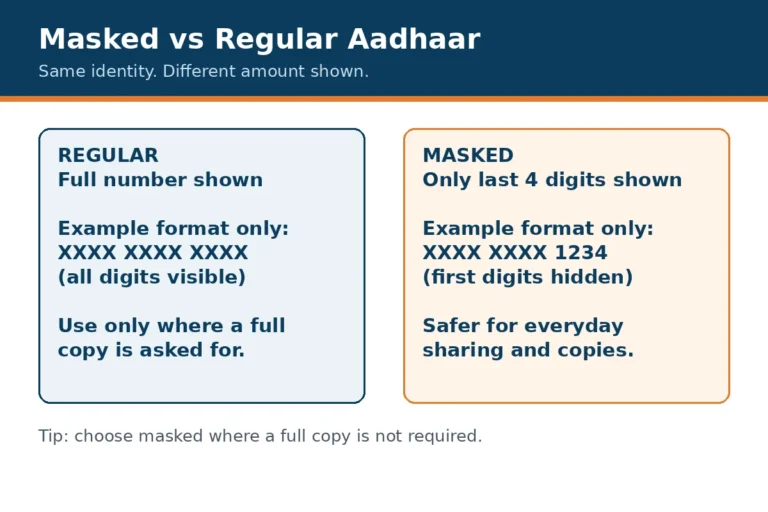
- Share a copy only when it is genuinely asked for, and prefer a masked copy where that is accepted. See Masked Aadhaar Download for how masking works.
- Never share a child’s details, or a parent’s password or one-time code, with unofficial helpers.
- After an update, check the new details. See Aadhaar Update Status by URN if you are waiting for a correction to finish.
Related guides
Start from the homepage for the full overview, including how to download a copy and how to check an update.
One Comment